What is TheoremGraph?
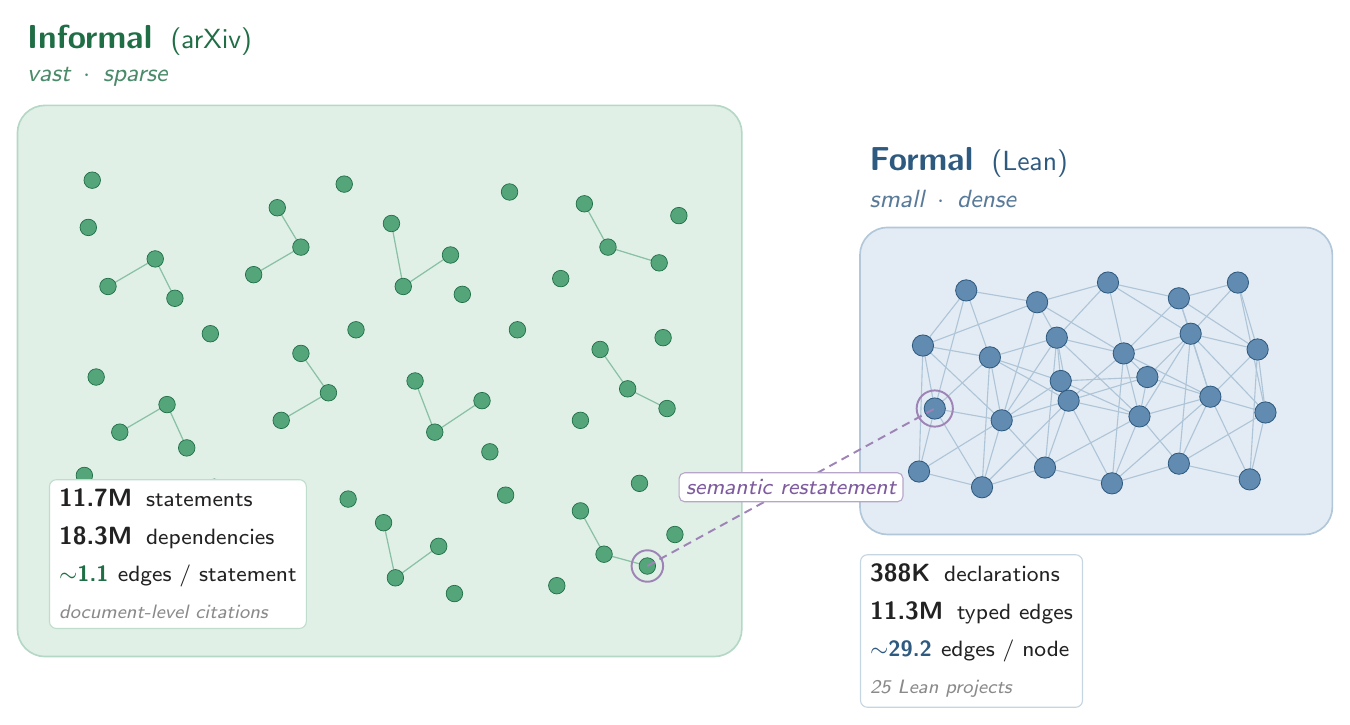
It is an informal dependency graph of results from papers, a formal dependency graph of declarations in Lean, and a set of links between statements that express the same mathematics.
Those links show where published mathematics meets machine-checked mathematics.
The hypothesis of this talk is that this map can help us choose formalization targets and build better context for proof agents.
What do the two sources give us?
 arXiv
arXiv
arXiv is a public repository of research papers and their source files.
- Choose mathematical subject categories.
- Read paper metadata and the LaTeX document.
- Use the bibliography and local references to recover structure.
 Lean
Lean
Lean gives us a checked environment rather than a document.
- Resolved declaration names and types.
- Proof terms accepted by the kernel.
- The declarations each result depends on.
Most correspondences have never been written down.
The literature is broad, Lean is exact, and blueprint projects expose only a sparse set of hand-authored links between them.
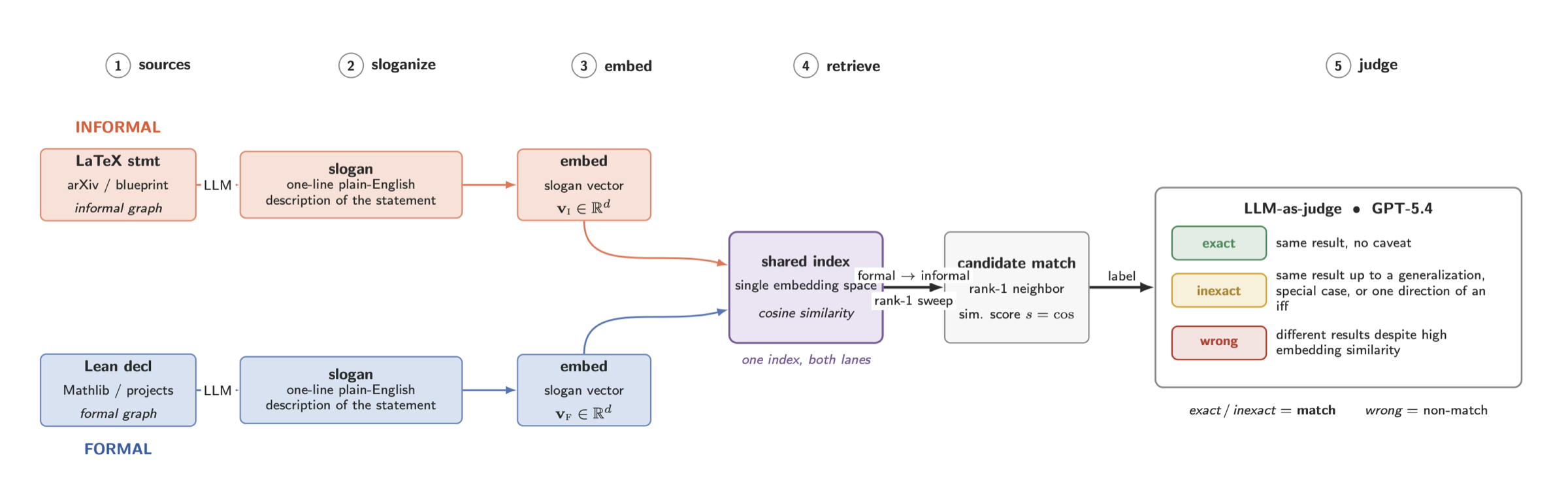
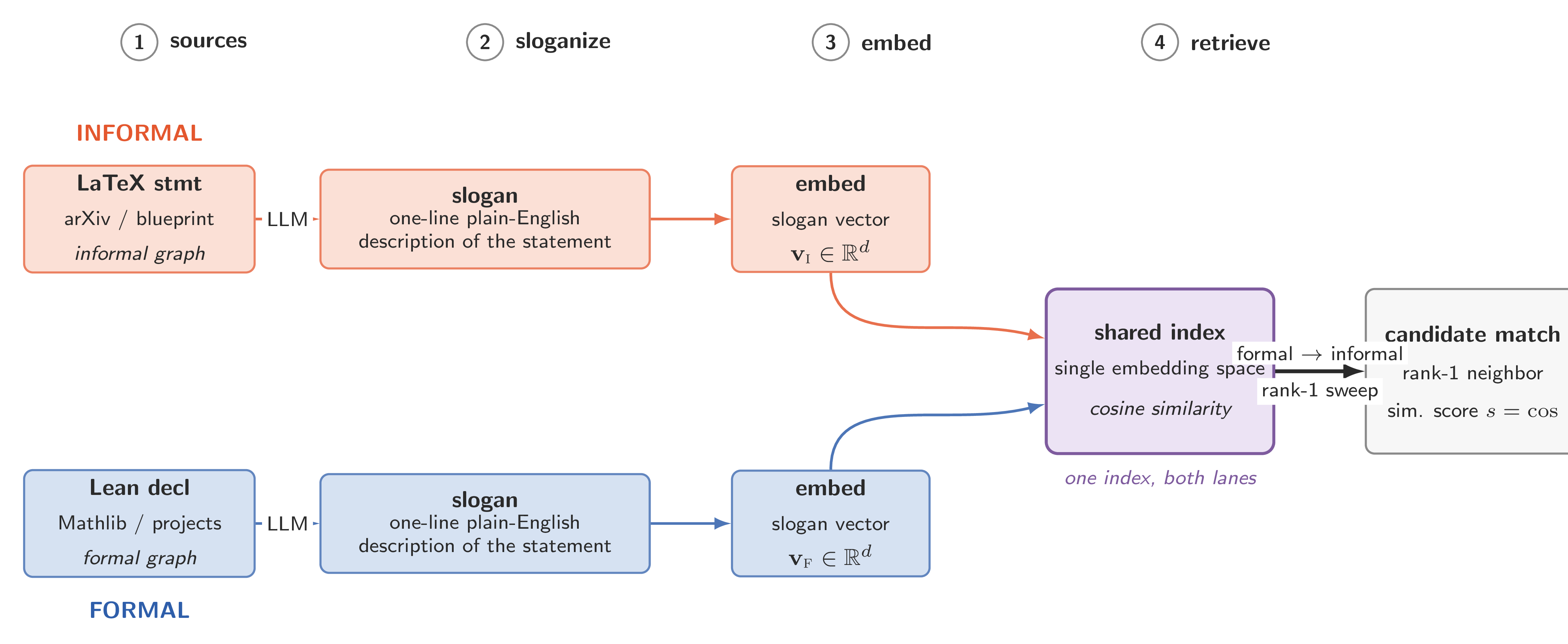
Use one embedding space for both corpora.
Qwen3-Embedding-8B maps every slogan to a normalized 4,096-dimensional vector.
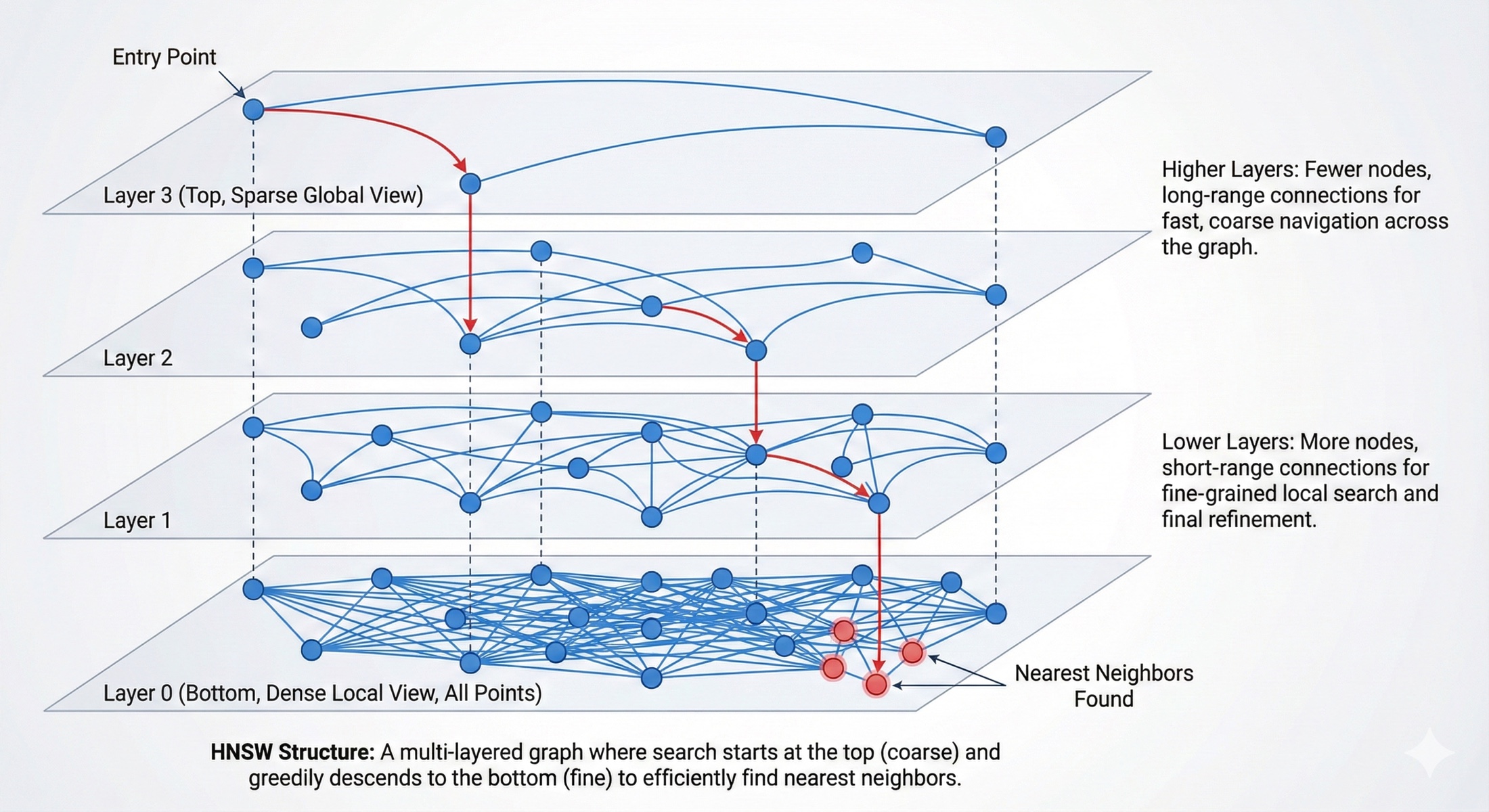
What is HNSW?
HNSW is an approximate nearest-neighbor index. It takes long jumps through sparse upper layers, then descends into denser layers to refine the search.
ann_k is the shortlist kept from approximate search before exact cosine reranking. Larger values cost more, but are less likely to discard a good neighbor.
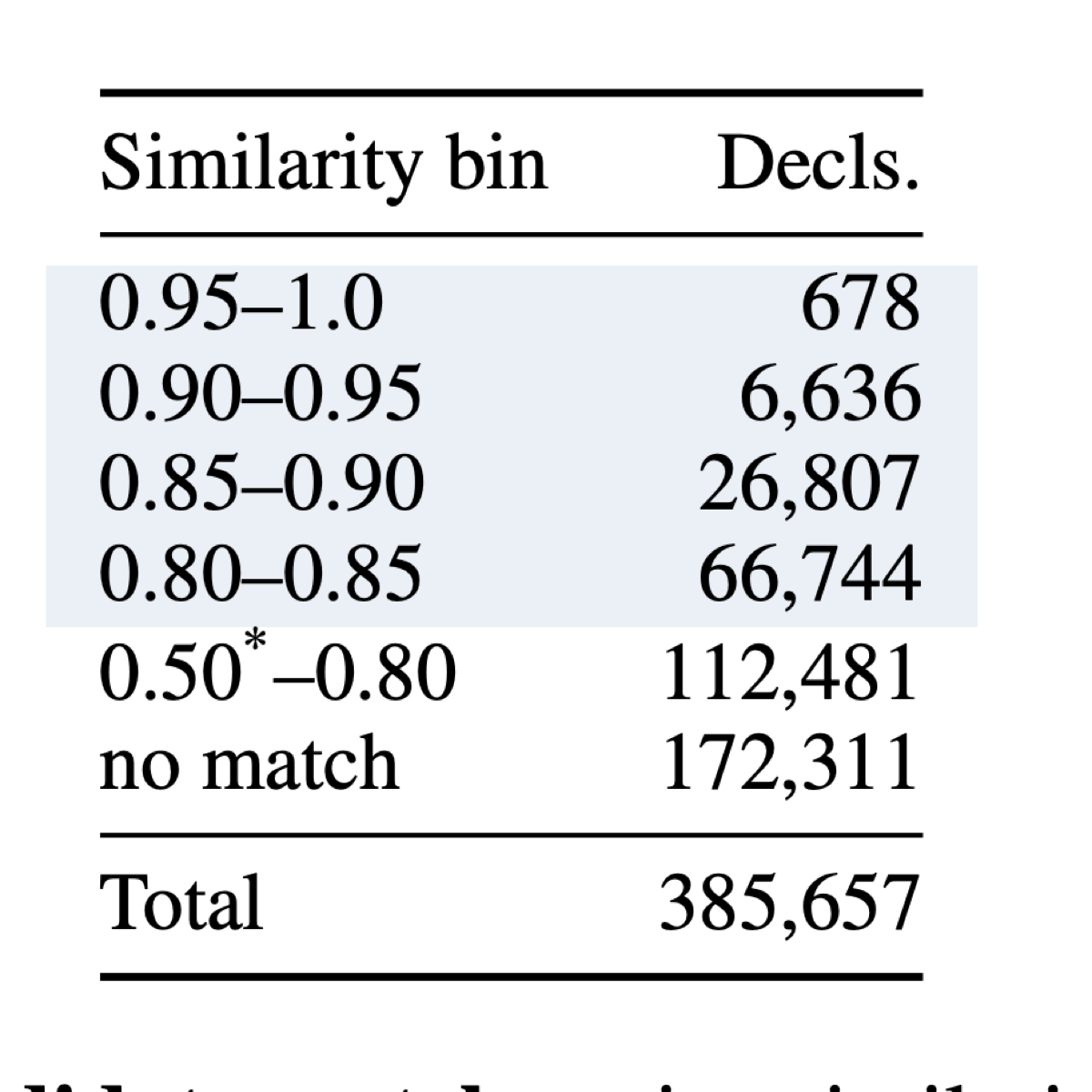
Most formal declarations do not produce a close paper neighbor.
213,346 declarations return a candidate at the minimum retrieval similarity.
100,865 land at cosine 0.8 or above and enter the fully judged tiers.
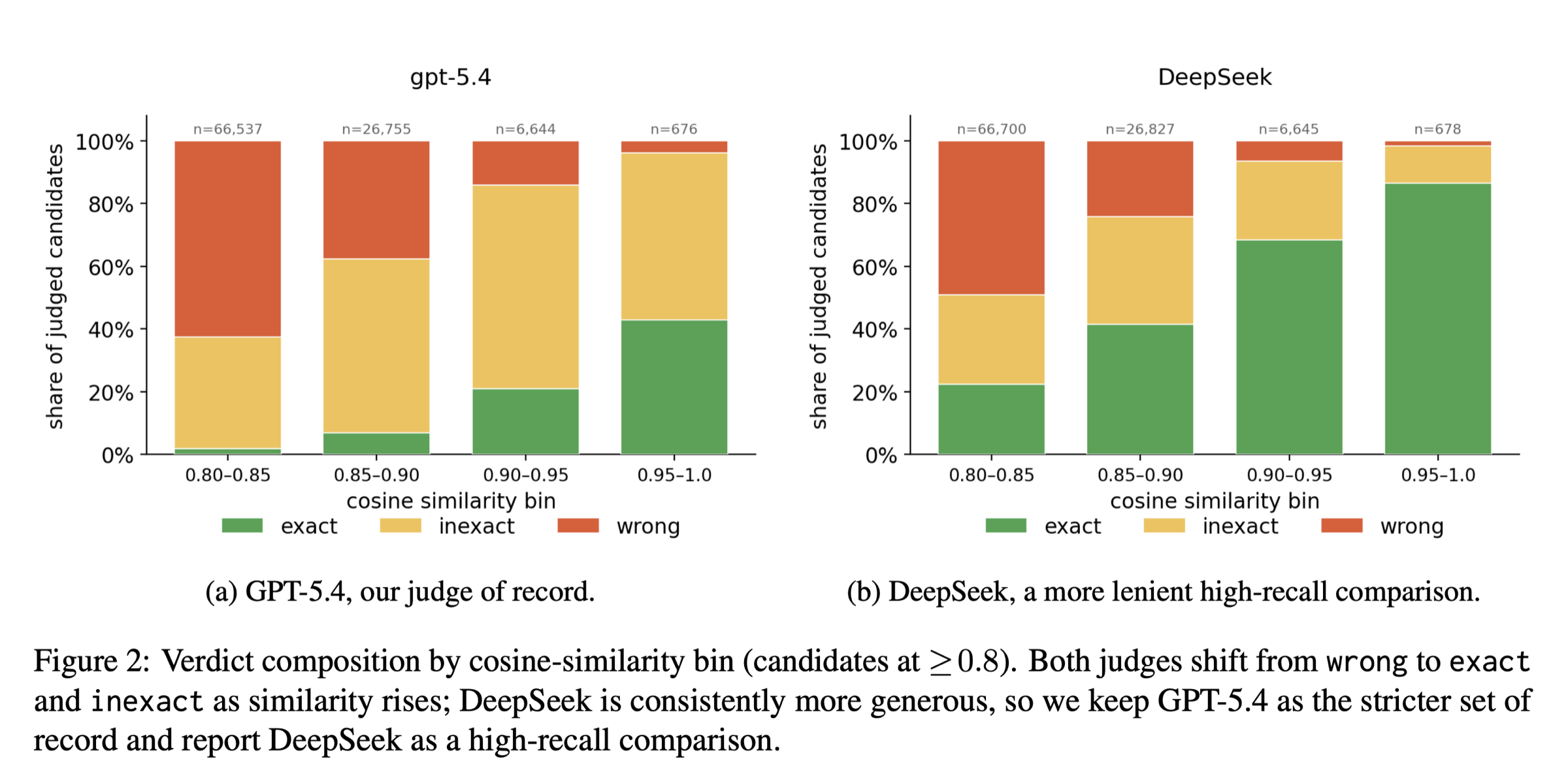
Judge policy changes the density of the resulting graph.
Both judges affirm more candidates as cosine rises, but DeepSeek is consistently more lenient. GPT-5.4 remains the stricter judge of record.
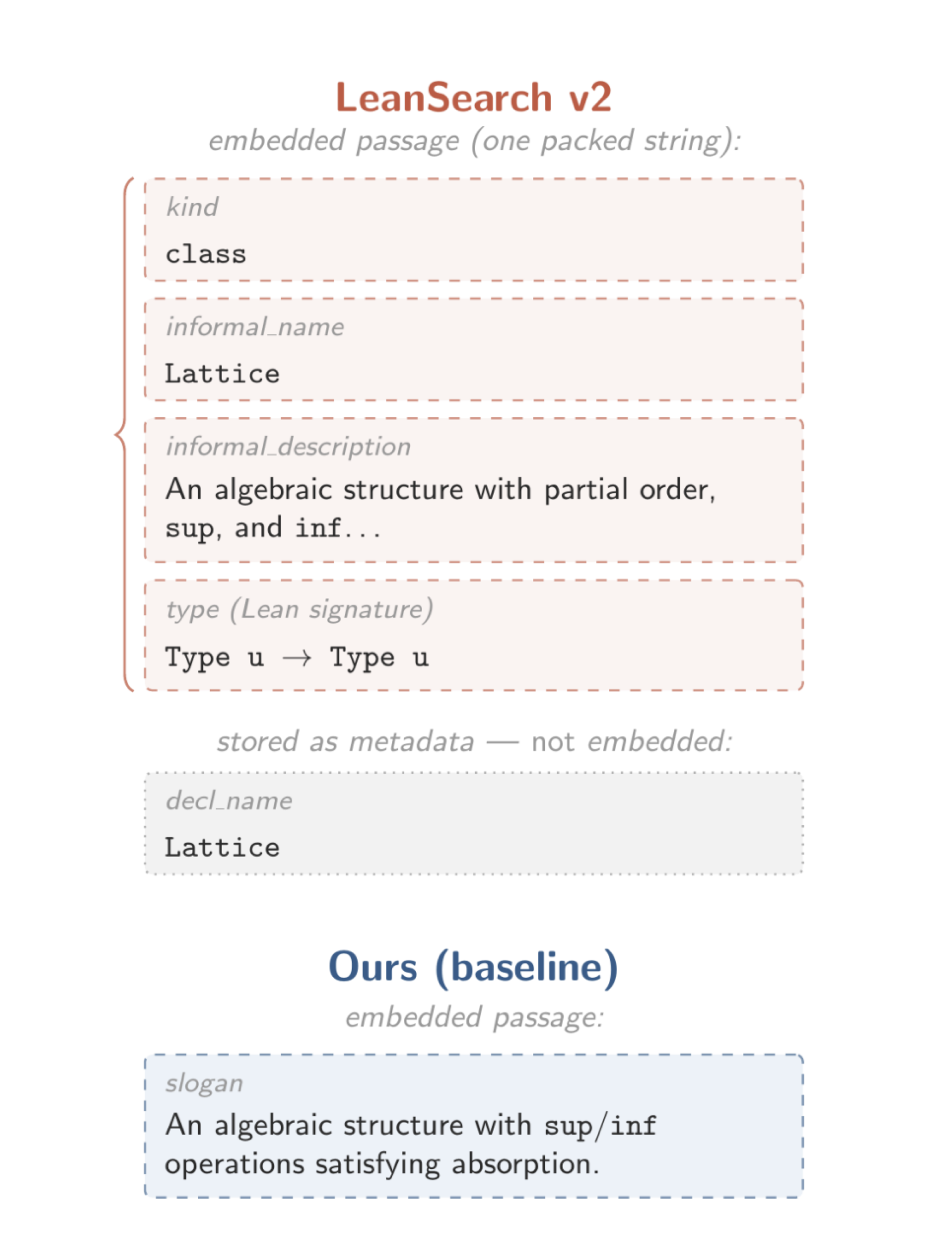
Put names and signatures where queries can reach them.
- Name and signature: embed the fully qualified name and Lean type alongside a second representation.
- Name index: give bare-name queries a direct lexical route.
- HyDE: restate terse or Lean-like queries in language closer to indexed descriptions.
Keep good candidates alive, then expand through the graph.
Approximate search is fast because it prunes aggressively. The risk is that the right declaration disappears before we score the shortlist exactly.
- Wider shortlist:
ann_kis how many approximate neighbors survive into exact cosine scoring. Increasing it gives plausible declarations another chance. - Exact reranking: recompute cosine over that candidate pool.
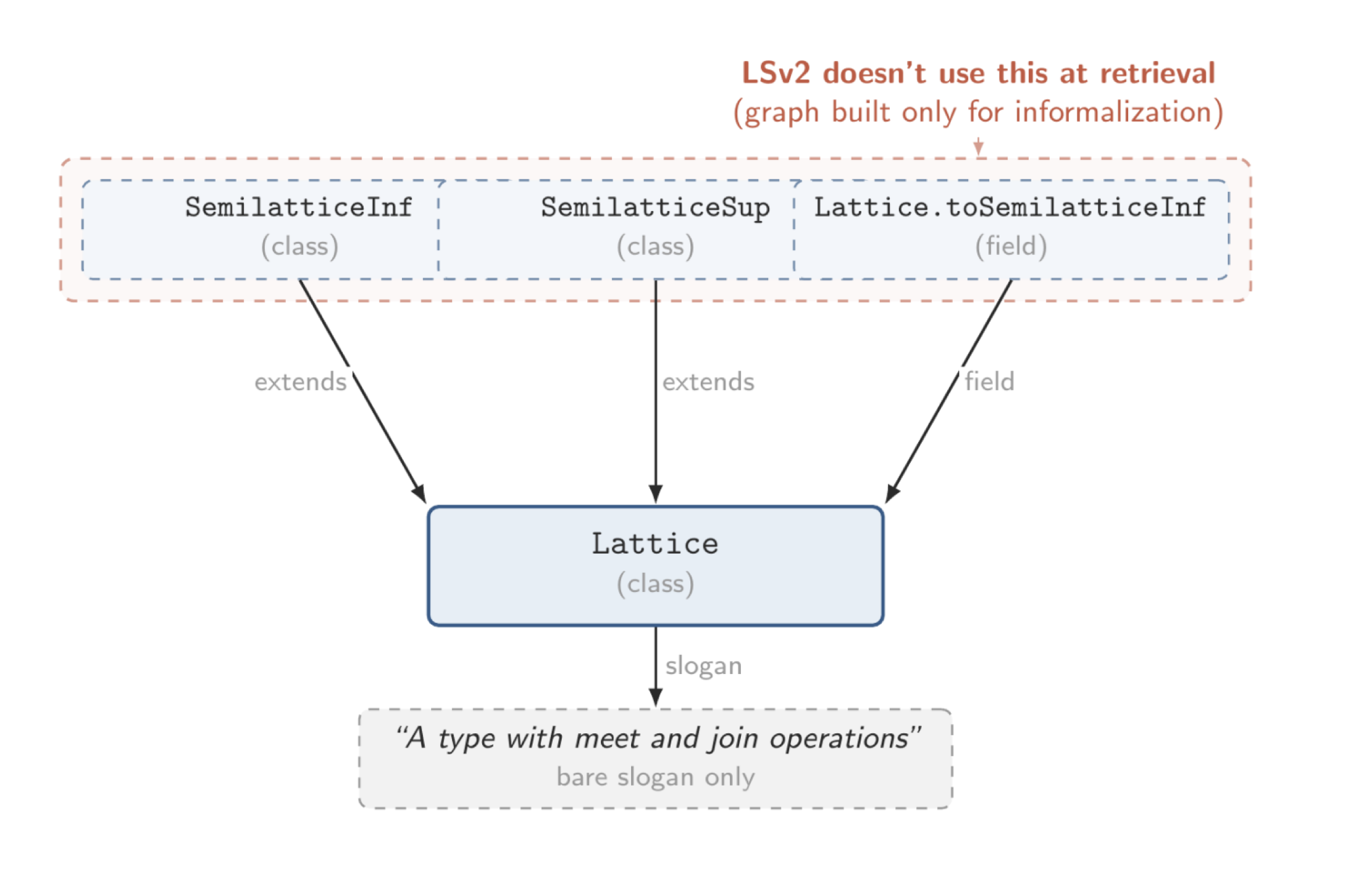
- Graph expansion: a retrieved declaration may be one dependency hop from the intended concept. For
Lattice, that hop surfaces names such asSemilatticeInfandSemilatticeSup.
TheoremGraph